The invention of Elevator is credited to Elisha Otis. What a thought on 1852. Never knew they had a necessity in centuries back. Rest is history, the well known OTIS Elevators Company started by the inventor remains to this day. Today elevators are ubiquitous. Currently this age with obesity common among people, I know climbing stairs is one of the best excersie to burn calories after a meal, but how can we ignore not using such an invention. Please prepare a 10 min test report of yours before reading further. And I’m sure you’ll enjoy the test.
1. Tests to verify interesting functions:
1.1 Verify Open / Close functionality works fine with motion sensor in place. Make sure the motion sensor is present in door from the bottom to the top of the door. This helps when a short kid steps in on close of the door; it keeps the door away from closing. Remember to test with a non living thing.
1.2 Control program in the elevators should consider i) where people want to go ii) where each floor is and iii) where the elevator car is
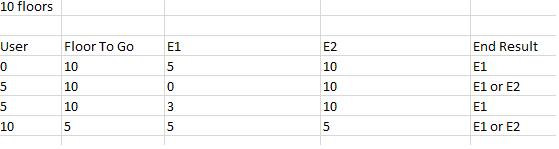
Considering the above for two elevators E1&E2, if suppose E1 is in ground floor, the E2 in fifteenth floor and you are in fifth floor waiting to go to floor 2, then E2 in ground floor should get a trigger and reach you first. Please see the matrix below.
1.3 Not Transparent:
1.3.1 The above matrix gets tougher to figure out when there are more than 2 Elevators. Prediction are quite ambiguous since control program takes more conditions based on various states. Haven’t achieved intelligibility in this.
1.3.2 If not being used check which floor does it hang about? Will it remain in the last stopped floor? Will the doors be opened? I observed that they remain in the last stopped floor and the doors were opened. Few companies prefer it on the ground floor.
2. Tests to verify emergency functions:
2.1 Emergency light in the elevator in case of power failure
2.2 Buzzer to raise an alarm to the security
2.3 Phone being functional
2.4 Exhauster fan to avoid suffocation
2.5 Stop button taking you to the immediate level and bring to an end
2.6 Not Transparent:
How they freeze the operation when there is a fire mishap is still a question? I believe there is greater controller which controls when to start operation and stop operation. Not much clarity on this since I couldn’t figure out where this is in my office. Please add your comments if you have any thoughts on this.
3. Tests to verify load:
3.1 The elevator should halt before taking off if the weight limit is surpassed
3.2 A buzzer should ring to raise the alarm that weight limit has been breached
3.3 Not Transparent :
I came across interesting news when I was reading about elevators. Have you noticed almost in all the lifts there will be a warning information that the capacity of persons (for example 15 Persons). Why is that? Any guess? Is it because of space issue? No.
Did manufacturer guess the average weight of the person based on that the cumulative weight and person’s capacity? Well, no. Because the moment it crosses the weight limit, the elevator won’t move. So you need not do any mental calculation by counting men, that’s erroneous. Do they test with some load inside or is there a simulation for these control programs? Not sure.
4. Out of box ideas (improvement we can look for)
4.1 Mobile reach-ability inside elevator. Mobile phones hardly work when you are inside the elevator due to poor network coverage. Should this be considered?
4.2 Braille on buttons can be included to help the blind
True, we have missed the obvious ones like verifying display of floor number on LED lights and so on. Since they are obvious and no one will miss them, we have ignored them. Share your thoughts or test report in the comments section. I’m sure your thought will be helpful to many to think better.
Happy testing!!!
5. Resources
Etymology: Elevator late 15c., from Latin elevatus, pp. of elevare "lift up, raise," figuratively, "to lighten, alleviate," from ex- "out" (see ex-) + levare "lighten, raise," from levis "light" in weight (see lever). Related: Elevated; elevating.
Words with same root: lever, levitate. They all mean “to raise”